
Troubleshooting SAP System Connections
This page collects known problems that you might encounter in SAP systems when connecting Teamscale to the SAP system.
"Master-System darf nicht initial sein" (Master system must not be initial)
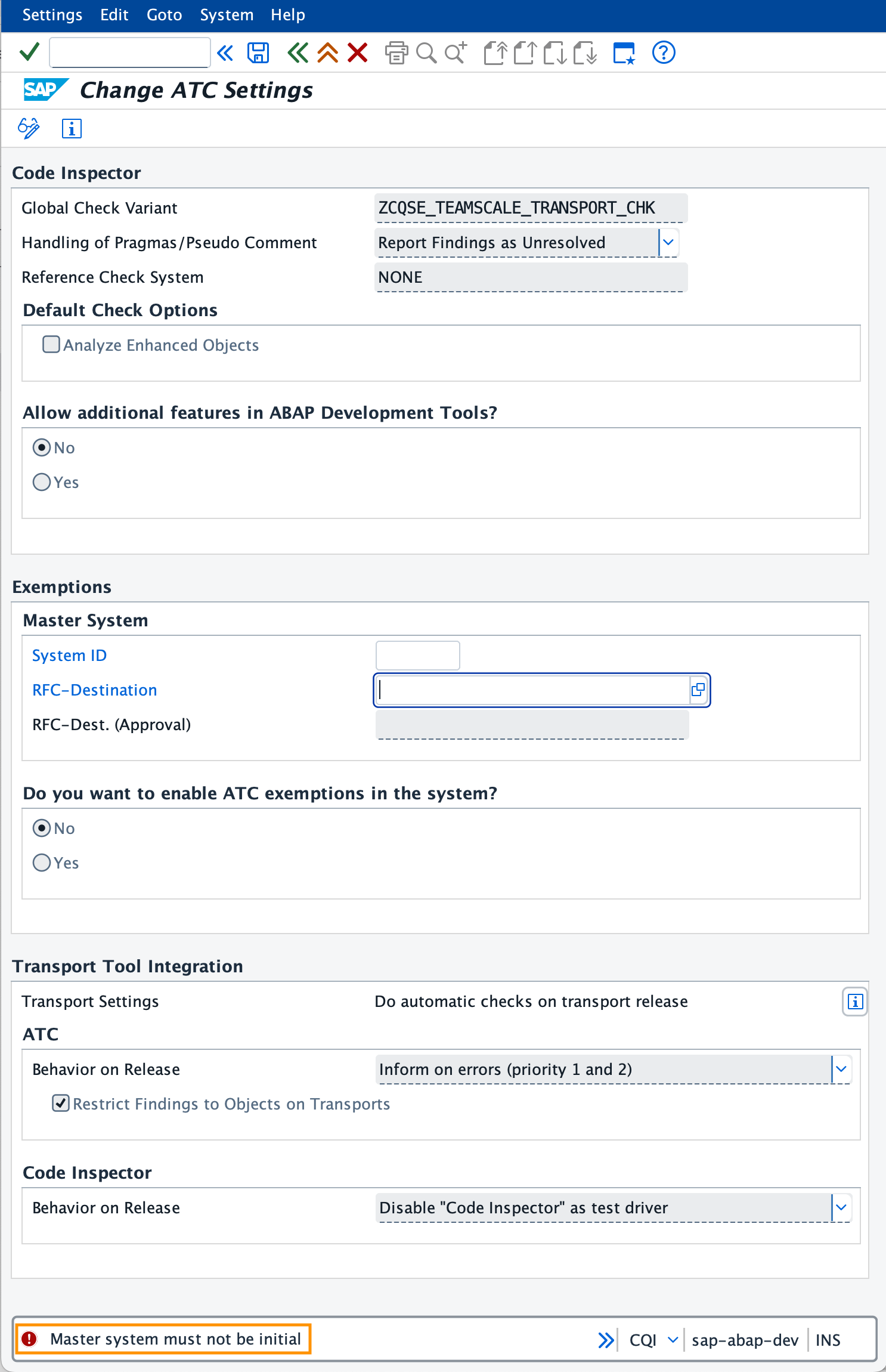
This error can be resolved by setting the System ID field in the Master System section to the ID of the SAP system itself.
"RFC-Destination des Referenzprüfsystems existiert nicht" (RFC destination of the reference check system does not exist)
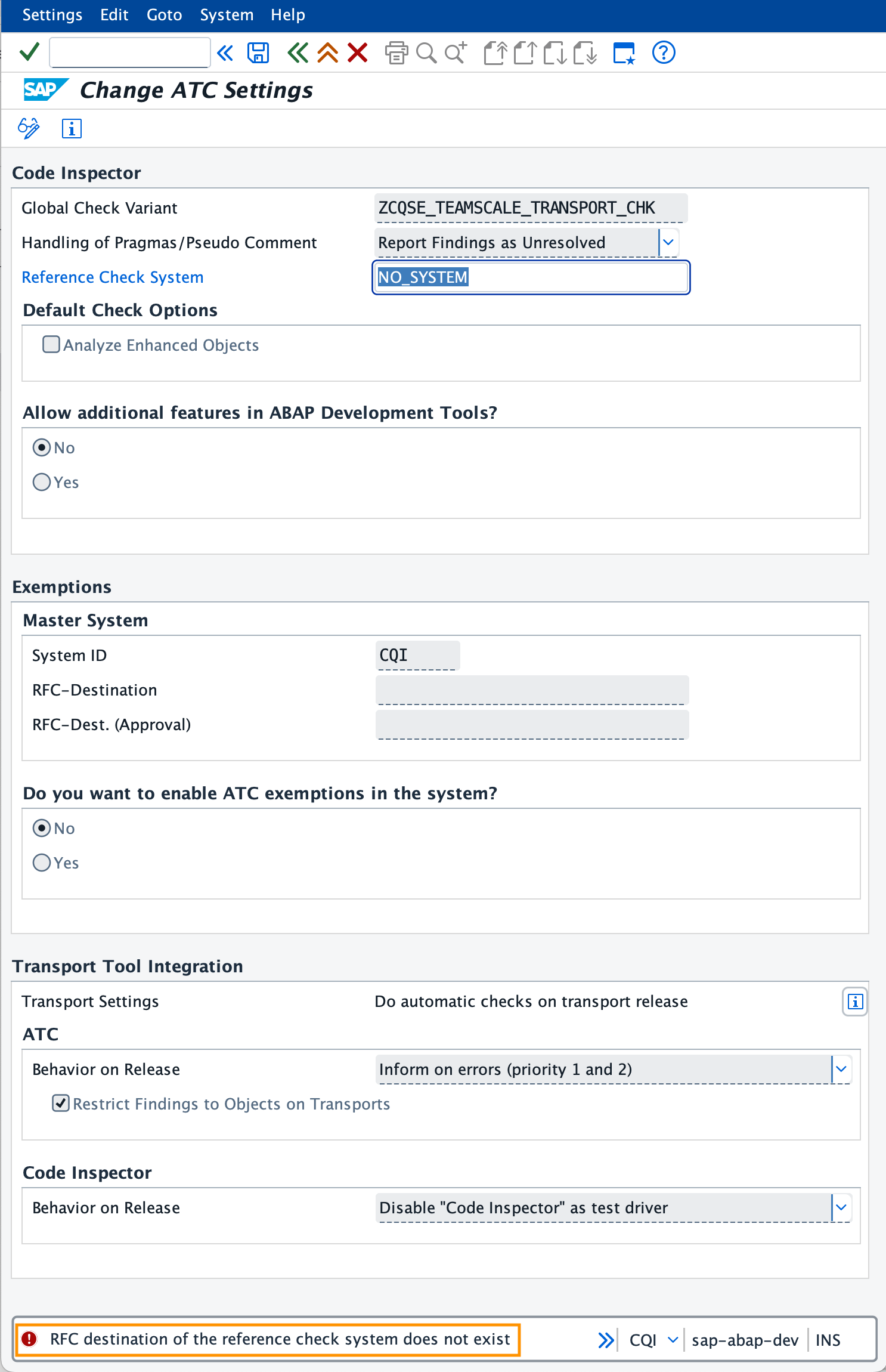
Generally, if the project is applying "central quality checking", fields like Master System or Reference Check System should be filled according to the ATC documentation.
However, if only "local quality checks" are applied, please use the ID of the SAP system the ATC is configured for, put its ID in the Master System field and use NONE as value for the Reference Check System field. NONE is a predefined RFC destination in the SAP system (see RFC Destination).
"Data inconsistency in table SATC_AC_CMM"
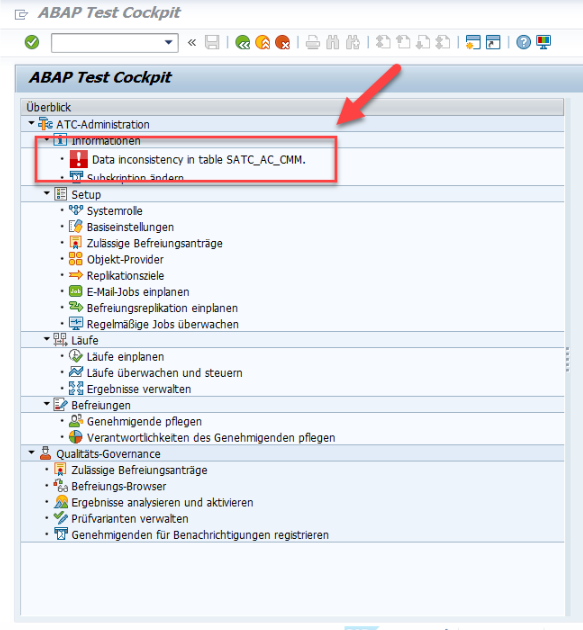
There are several potential symptoms of this issue:
- The runtime error
DBSQL_DUPLICATE_KEY_ERRORoccurs inCL_SATC_CI_CF_TOOL=>CREATE_CONFIGURATION - Entries in ATC results have wrong titles or messages (e.g.,
not available) - ATC results contain duplicate entries
To resolve this issue, implement SAP Note 2987681. Then execute SATC_CORRECT_INCONSISTENT_IX once. This is possible only if no other ATC run is active at the same time.
SAP Connection: The Teamscale technical user seems to create or modify objects
For entries in the REPOSRC table or the TRDIR view, the CNAM or UNAM columns may contain the name of the technical user used by Teamscale. This does not mean, however, that Teamscale silently created or changed source code in your customer namespace, as the entries are merely ==CS includes belonging to global ABAP classes.
These ==CS includes are used for the source-code-based class editor and contain the “complete source code” (hence the CS suffix) for the class. Because Teamscale needs to retrieve code for all ABAP classes in your namespace, the SAP system may first have to generate such a source-code-based representation. Only this representation will be generated under the Teamscale user account. The corresponding objects, however, will still contain the actual creators and modifiers, so tools like SE80, transport management, or the ABAP Development Tools for Eclipse will behave as expected and show the correct user accounts.
RFC connections are forbidden by UCON
The SAP Unified Connectivity (UCON) component in SAP systems is used to secure communications. Access to RFC functions can be granted or restricted in the UCON configuration. If you get an error message containing Error during executing ABAP function /CQSE/... and JCO_ERROR_SYSTEM_FAILURE: UCON RFC Rejected; in the Teamscale worker log, then the RFC function mentioned in the message must be allowed in the UCON configuration.
No coverage information arrives in Teamscale
If the results do not look as expected, most of the time it is enough to use the repair functionality that is included in SAP Coverage Analyzer. Execute transaction SCOV and run the consistency checks with repair option:
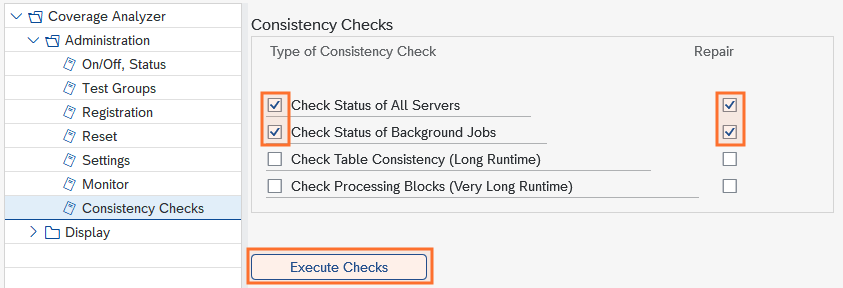
Afterwards, you can check the Monitor view for errors. If there are old errors, which are obsolete after the repair, these can be cleared by selecting a line and clicking Completed as shown here:
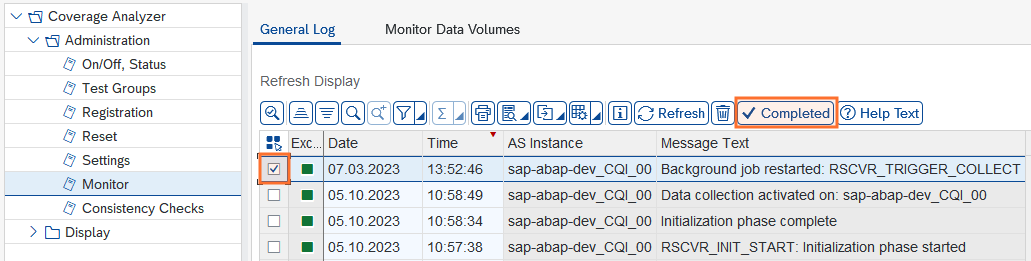
In case of problems with the batch job RSCVR_TRIGGER_COLLECT, please make sure the user configured for the job does still exist and is not locked.
Check also that SCOV is active at all, as described in Ensuring SCOV is Active.
Teamscale and UPL report conflicting coverage
If you would like to use Teamscale to analyze coverage information from a system that is already using Usage Procedure Logging (UPL), there are a few things to consider. Otherwise, these tools may interfere with each other and produce incorrect results. In essence, both the coverage-enabled Teamscale export and UPL use the same raw data created by SCOV Lite in the system table COVRES. However, when UPL extracts that data via the batch job /SDF/UPL_PERIODIC_EXT_JOB every 24 hours, it empties that table, whereas the Teamscale Connector does not.
This means the Teamscale export should run briefly before the UPL extraction job. In order to find out when that job is scheduled, you can either use transaction SM37 in the SAP system or have a look at the file job_status.csv in one of the exported zip files. Afterwards, adjust the polling schedule for coverage data in your SAP System Connection to run a few minutes before that time. You may still have multiple updates per day, as long as one of them always runs shortly before the UPL extraction job.
The connection test fails even though the root certificate is trusted
If your Teamscale server has restrictions with respect to accepted TLS ciphers, you may need some additional modifications. For example, if only TLSv1.2 with perfect forward security (ECDHE ciphers) is allowed, on some SAP systems you may need to enable this with profile parameters in the SAP system first:
- Use transaction
RZ10, select the DEFAULT profile and extended maintenance > change. - Create or modify the parameter
ssl/client_ciphersuitesand set it to908:PFS:HIGH:MEDIUM:+e3DES. - Save and activate the changed profile (respective dialogs will appear).
- Restart the SAP application server.
Recent SAP systems generally do not require this. Further information can be found in the SAP Community.